If you’re new to affiliate marketing and searching for the best course to get started, you’ve probably noticed something confusing.
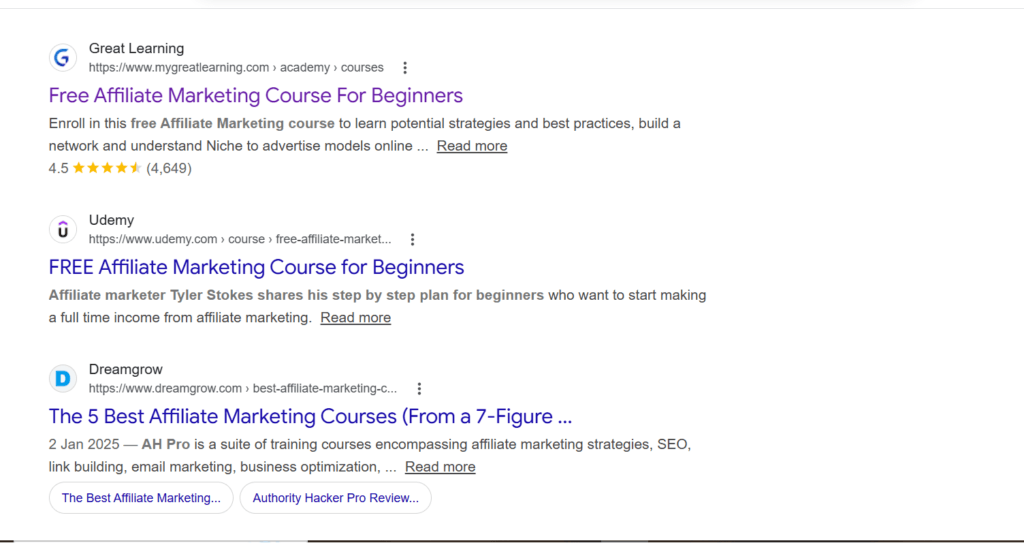
When you search on Google or Bing, the first results are sponsored ads. Scroll further down, and you’ll see two types of options:
- Free affiliate marketing courses
- Paid affiliate marketing courses
So which one should you choose?
Let’s break it down clearly so you can make the right decision.
Free Affiliate Marketing Courses : Are They Enough?
There are several free courses available online. One common example is a short certificate-style course that gives you a basic introduction to affiliate marketing.
These free programs usually cover:
- What affiliate marketing is
- How people make money from it
- Basic terminology
- A general overview of the process
And that’s helpful.
If you’re brand new, this kind of course can give you clarity. It helps you understand the structure of affiliate marketing and how the model works.
But here’s the problem.
Most free courses are only two to three hours long. They focus on theory, not real execution.
If your goal is just to understand affiliate marketing, that may be enough.
But if your goal is to build a real affiliate marketing business and create sustainable income, you will need something deeper.
Why Paid Courses Exist
If you want to turn affiliate marketing into a serious income stream, you need more than theory.
You need:
- Step-by-step structure
- Practical implementation
- Ongoing support
- A clear traffic strategy
- Guidance when you get stuck
That’s where paid courses come in.
However, not all paid programs are equal. Many promise quick riches. Some focus heavily on hype. Others teach tactics that are not sustainable.
So instead of asking, “Which course is best?”
You should ask, “How do I evaluate a course properly?”
Let’s look at the right way to do that.
How to Choose the Right Affiliate Marketing Course
Before you hand over your credit card, you need to play detective. A good course creator will be happy to answer your questions. A scammer will try to avoid them. You can ask these questions by email, in a Facebook group, or even just look for the answers on their sales page and in their free YouTube videos.
Here are the most important questions to ask, broken down into four simple categories.
Category 1: Questions About the Teacher (The “Who”)
First, you need to know if the person or people teaching the course are the real deal.
1. “Can they show you an example of an affiliate site they currently run?”
- Why ask: Anyone can say they’re an expert. You want proof. A real affiliate marketer has a blog, YouTube channel, or website they can point to.
- Red flag answer: “My main business is teaching this course.” This usually means they make their money by selling you a dream, not by doing the actual work.
2. “What was their biggest mistake when they started, and how did they fix it?”
- Why ask: This shows if the teacher is honest and humble. The best lessons often come from failures. If someone only talks about their wins, they’re probably leaving out the hard parts.
- Red flag answer: They dodge the question or act like everything was easy from day one.
3. “Do they stay updated on things like SEO and social media changes?”
- Why ask: The internet changes fast. A strategy that worked two years ago might be useless today. A good teacher never stops learning.
Category 2: Questions About the Course Content (The “What”)
These questions help you figure out if the course actually teaches you real, useful stuff.
4. “What is the main way the course teaches me to get traffic?”
- Why ask: Getting people to see your content (called “traffic”) is the hardest part of affiliate marketing. Is the course teaching you to use free methods like SEO (search engines) or Pinterest? Or does it expect you to spend money on ads right away? For a beginner, free methods are usually best.
- Red flag answer: “We teach all of them!” This often means they cover every topic, but very poorly. Or, they might be vague because their main method is out of date.
5. “Can I see a detailed outline of the course modules?”
- Why ask: A sales page might say “Module 1: Finding Your Niche.” But you want to know what’s inside that module. Does it teach you exactly how to find a topic with low competition? Or is it just a bunch of general ideas? The details matter.
- Red flag answer: They won’t share the details, or the outline is full of fancy words that don’t mean anything.
6. “Does the course give me step-by-step actions, or is it just theory?”
- Why ask: You need to know how to actually do things. Telling you “You need to do keyword research” is just theory. Showing you exactly how to use a tool to find the best keywords is practical.
- Green flag answer: They can give you a specific example of a lesson, like, “In the writing module, I share my screen and show you exactly how I write a blog post from start to finish.”
7. “Does the course have homework or action steps?”
- Why ask: You learn by doing, not just by watching videos. A good course will have checklists or assignments to keep you on track.
- Red flag answer: “It’s all videos. You can watch them whenever you want.” This leads to “analysis paralysis,” where you watch a ton of videos but never actually start your business.
Category 3: Questions About Help & Community (The “How”)
This tells you if you’ll have support when you get stuck.
8. “What kind of help is included if I have questions?”
- Why ask: Trust me, you will get stuck. You might have a question about how to install a plugin or understand a report.
- Green flag answer: “We have a private student group on Facebook where I answer questions every day,” or “We have a support team that replies within 24 hours.”
- Red flag answer: “You can leave a comment on the lesson page.” This usually means your question will sit there for weeks without an answer.
9. “Are there any live calls or Q&A sessions?”
- Why ask: Live calls are great for getting your specific questions answered and for staying motivated.
- Green flag answer: “I hold a live Q&A call once a month for all students.” If you can’t make it live, you can watch the replay later.
Category 4: Questions About Results (The “Why”)
These questions check if the seller is being honest about what you can really achieve.
10. “For a total beginner with no website, working about 10 hours a week, when could I expect my first commission?”
- Why ask: This is the ultimate test of honesty. It shows if they are selling a “get rich quick” scheme or a real business.
- Green flag answer: “It’s different for everyone, but you should spend your first 3-6 months just building your site and creating content. Your first sale might happen around month 4 or 5, but a steady income usually takes 9 to 12 months of hard work.”
- Red flag answer: “You could make money in your first week!” or “It all depends on you.” (This is just a way to avoid giving you a real answer).
11. “Can you share a student’s story, including the hard parts they went through?”
- Why ask: You want the whole story, not just the happy ending. Hearing about someone’s struggles and how they overcame them is way more helpful than just seeing a screenshot of a big paycheck.
- Green flag answer: “Sure, one student really struggled with picking a topic. Once she finally chose one she was passionate about, she stuck with it, and after 8 months she made her first $500. Her biggest lesson was learning to be patient.”
Your One “Golden Ticket” Question
If you only have time to ask one single question, make it this one. It combines all the ideas above:
“If I buy your course today, what is the very first thing you would tell me to do, and what is the biggest mistake I should avoid as a beginner?”
How they answer this tells you everything. A good affiliate marketing course will give you a clear, simple first step and will immediately warn you about common pitfalls, like picking the wrong niche or giving up too soon. A bad program will give you a sales pitch.
So, What’s the Best Affiliate Marketing Course for Beginners?
After evaluating many programs over the years, one option consistently stands out for beginners:
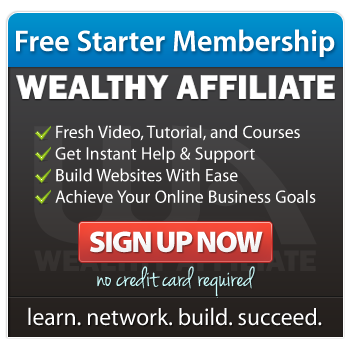
Wealthy Affiliate.
Why?
Because it allows you to:
- Learn and build at the same time
- Start with a free account
- Access structured training
- Get ongoing support
- Join an active community
Instead of just teaching theory, it focuses on implementation.
Instead of promising quick riches, it encourages steady, sustainable growth.
For beginners who want structure, tools, and support in one place, it provides a low-risk way to get started.